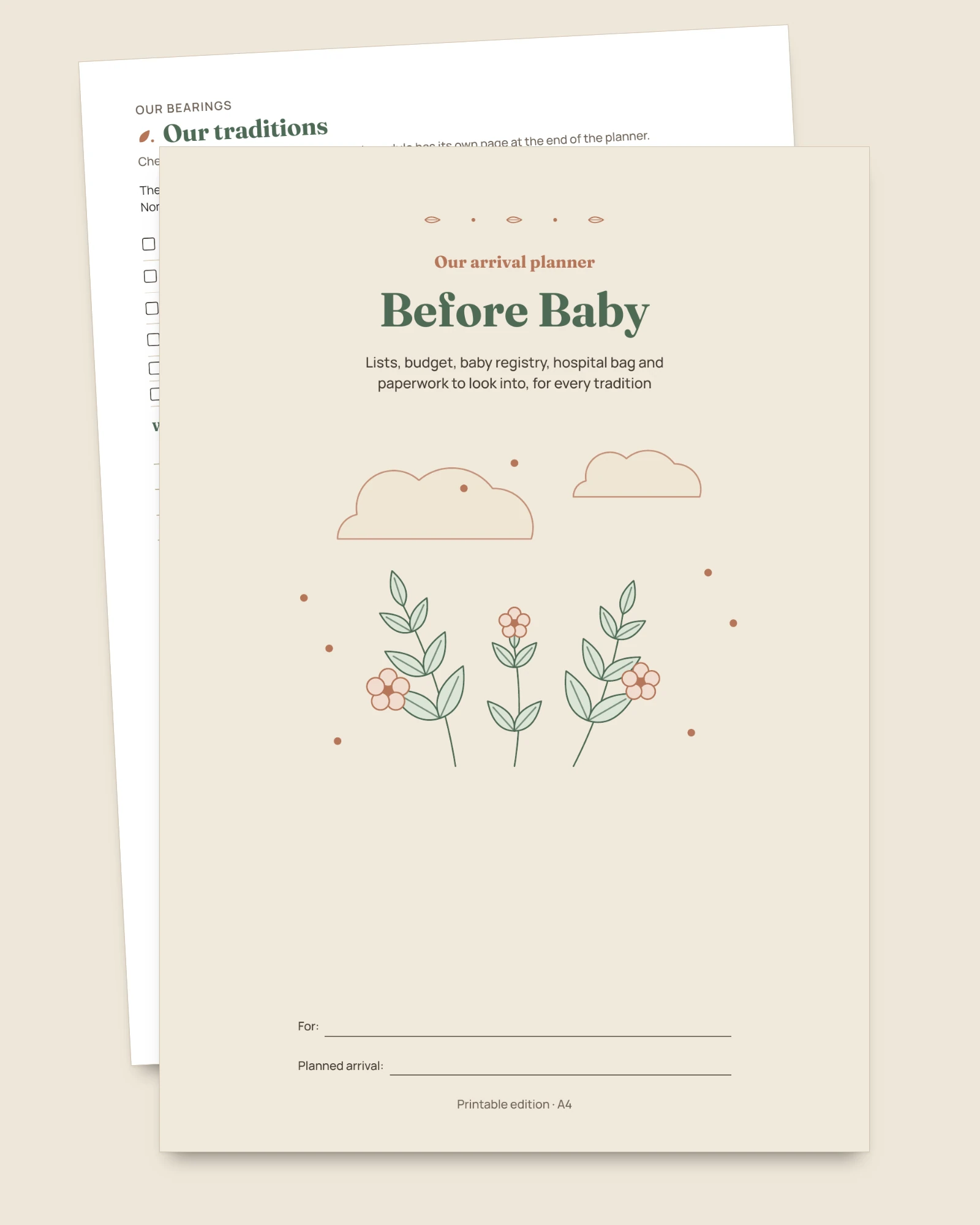
Lists, budget, baby registry, hospital bag and paperwork to look into, at your own pace. Nothing is dated, nothing is required.
A planner to print, and a workbook that does the totals
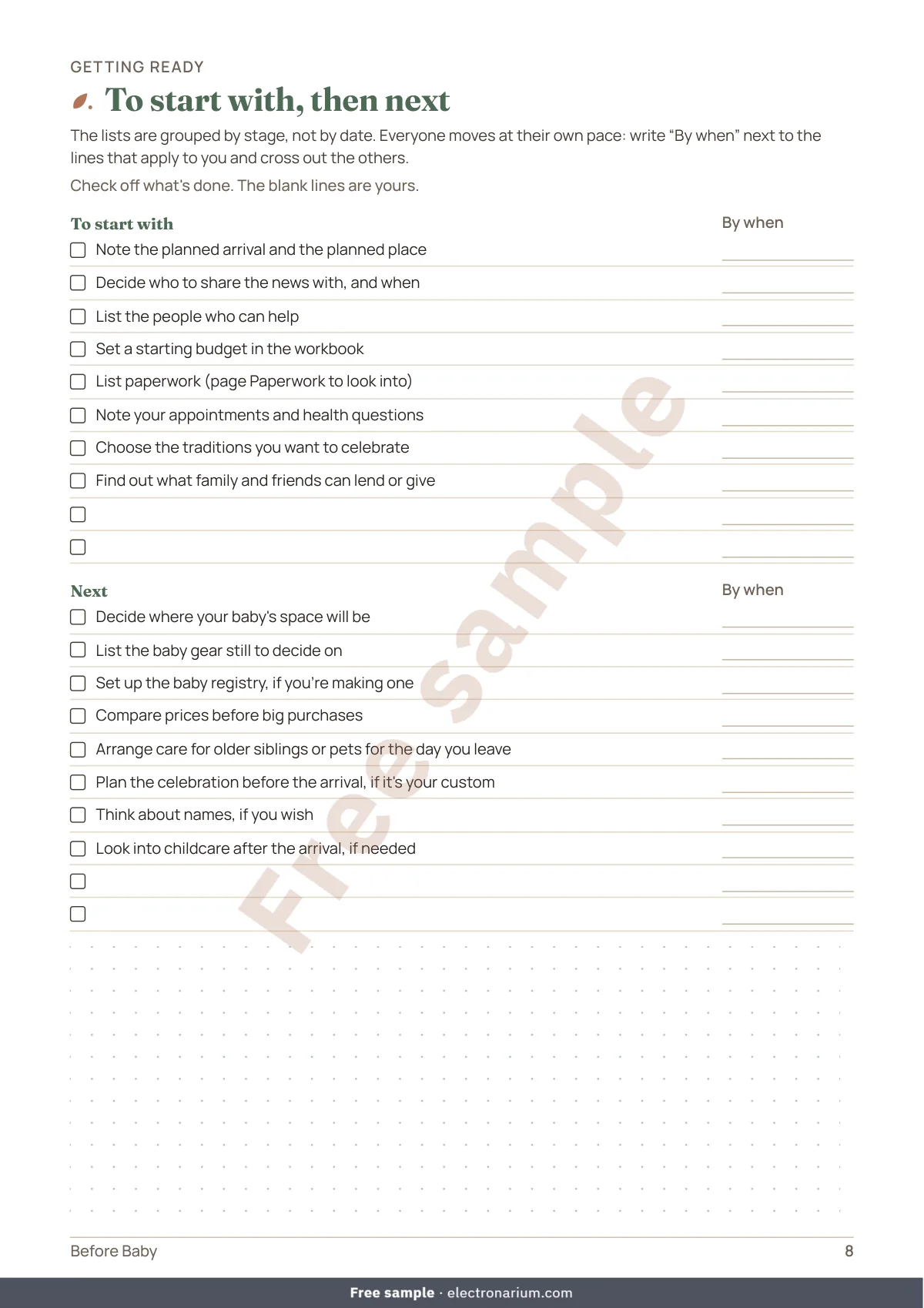
- Keep track without an imposed calendar: the lists are sorted by stage (to start with, next, before the arrival, after the arrival). Next to each line, a “By when” field you fill in if you want to.
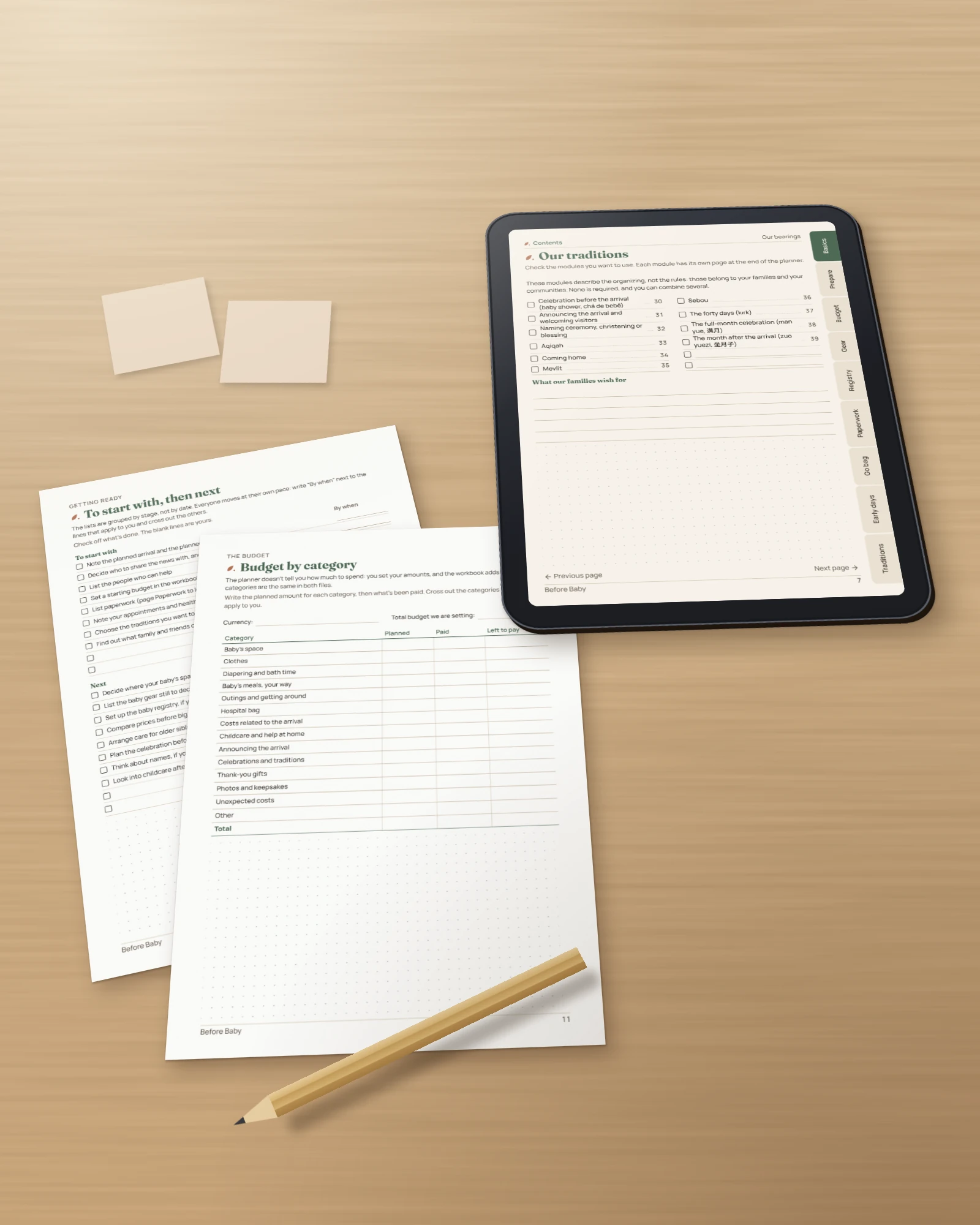
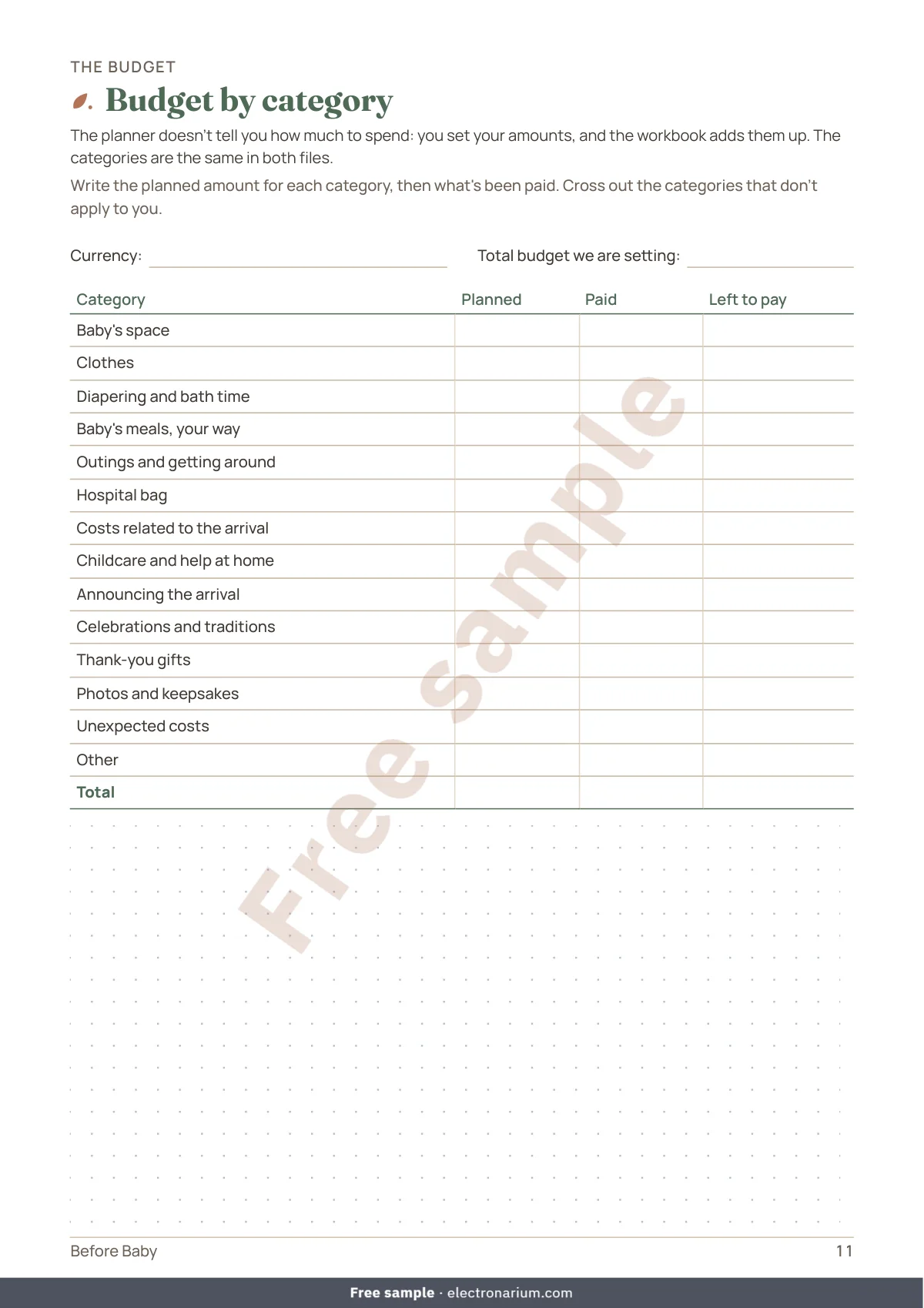
- Know where the money stands: a planned amount per category, what is paid, what is left to pay. The price paid for a purchase fills in the budget on its own. The workbook never tells you how much to spend: it adds up what you type.
- Buy, borrow, receive, or wait: each item is marked Purchase, Loan or Gift, new or secondhand, and Before the arrival, After the arrival or Not decided yet. If your family prefers not to buy anything before the arrival, the planner respects that.
- Follow the baby registry and the gifts: what you would like, who claimed it, what was received, and who to thank. The dashboard counts the thank-yous still to send.
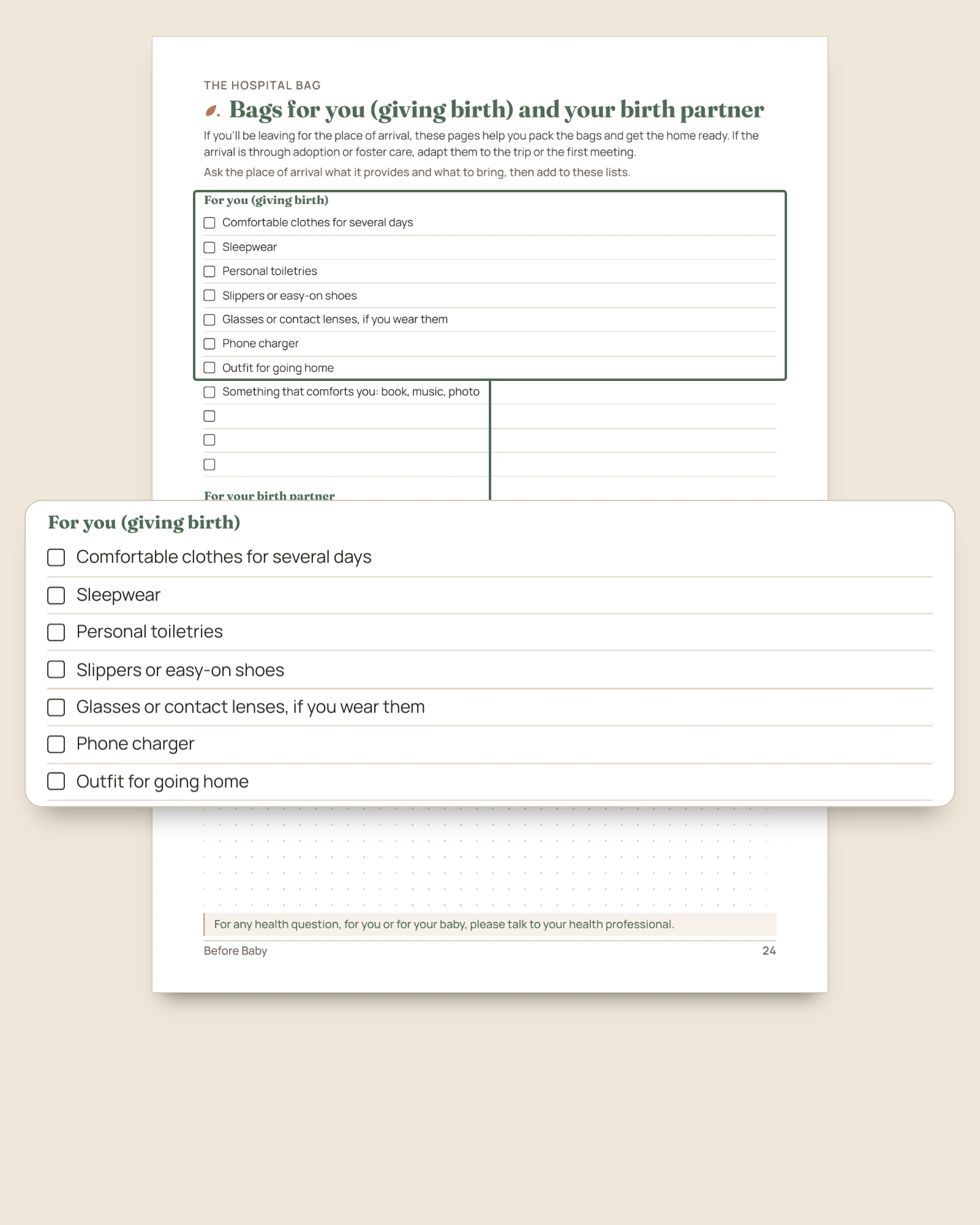
- Prepare for leaving home and for your time away: the hospital bag, if you need one, what to arrange while you are away (older children, pets, home) and help in the early days.
- For every family: the planner says “you” and talks about “the arrival”, whether it is a birth, an adoption or a foster placement. No family model is assumed.
- Paper or tablet: A4 or US Letter, readable in black and white, soft palette (sand, sage, terracotta); tablet version with a clickable table of contents, tabs and a link back to the contents on every page.
Your traditions, with no ranking
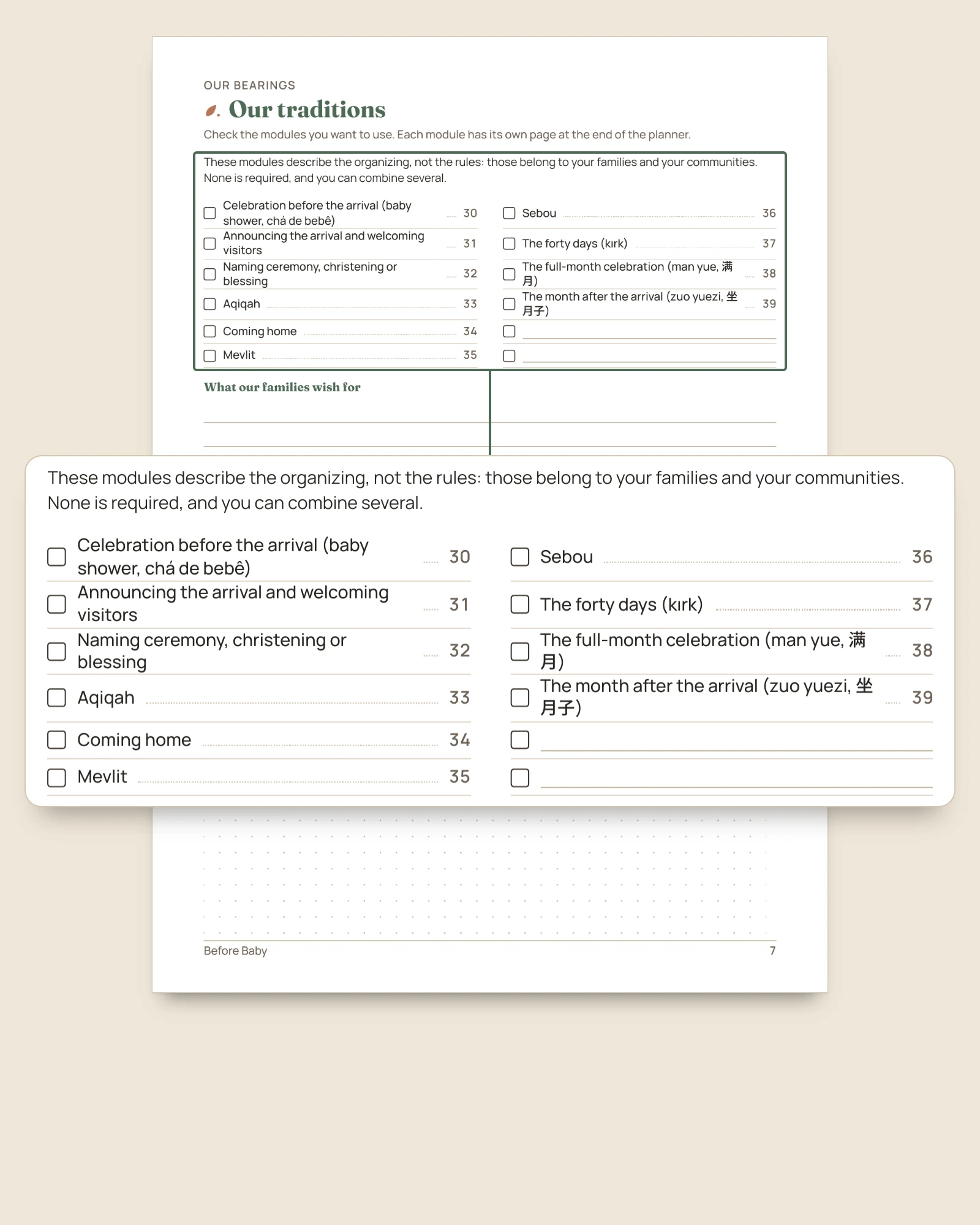
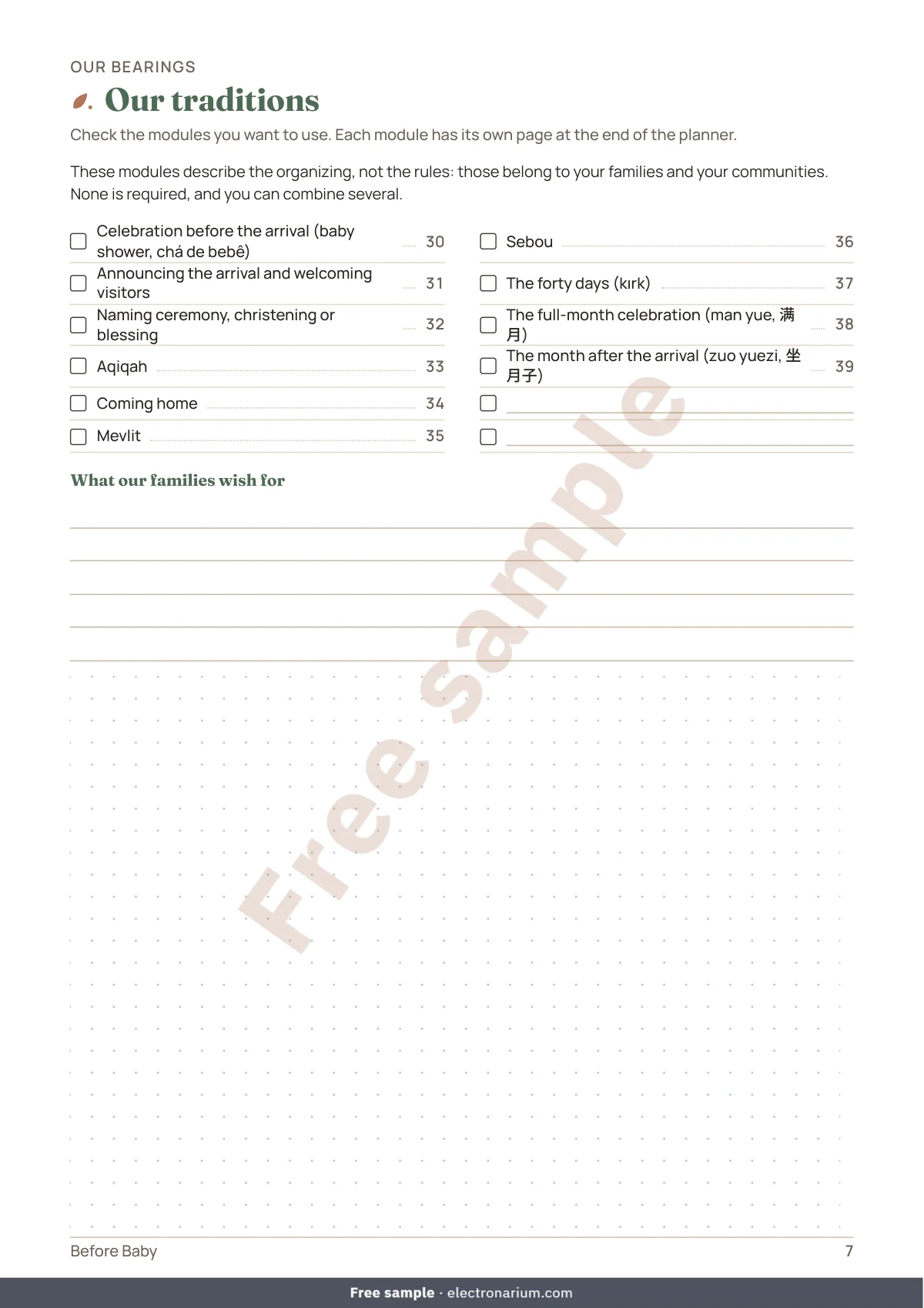
10 one-page modules, optional, to tick or to leave aside. Each one describes the organizing (who, what, where, when, how many people) and never the rules, which remain those of your families. First in this edition: Celebration before the arrival (baby shower, chá de bebê), Announcing the arrival and welcoming visitors, Naming ceremony, christening or blessing. Then: Aqiqah, Coming home, Mevlit, Sebou, The forty days (kırk), The full-month celebration (man yue, 满月), The month after the arrival (zuo yuezi, 坐月子). Blending two traditions? Tick both. The “Our traditions” page keeps 2 blank lines for your own.
Exactly what you get
- 4 files: the planner as an A4 PDF, a US Letter PDF and a tablet PDF (portrait 3:4, with links), and the workbook (.xlsx). The US Letter version has a few lines fewer on some pages.
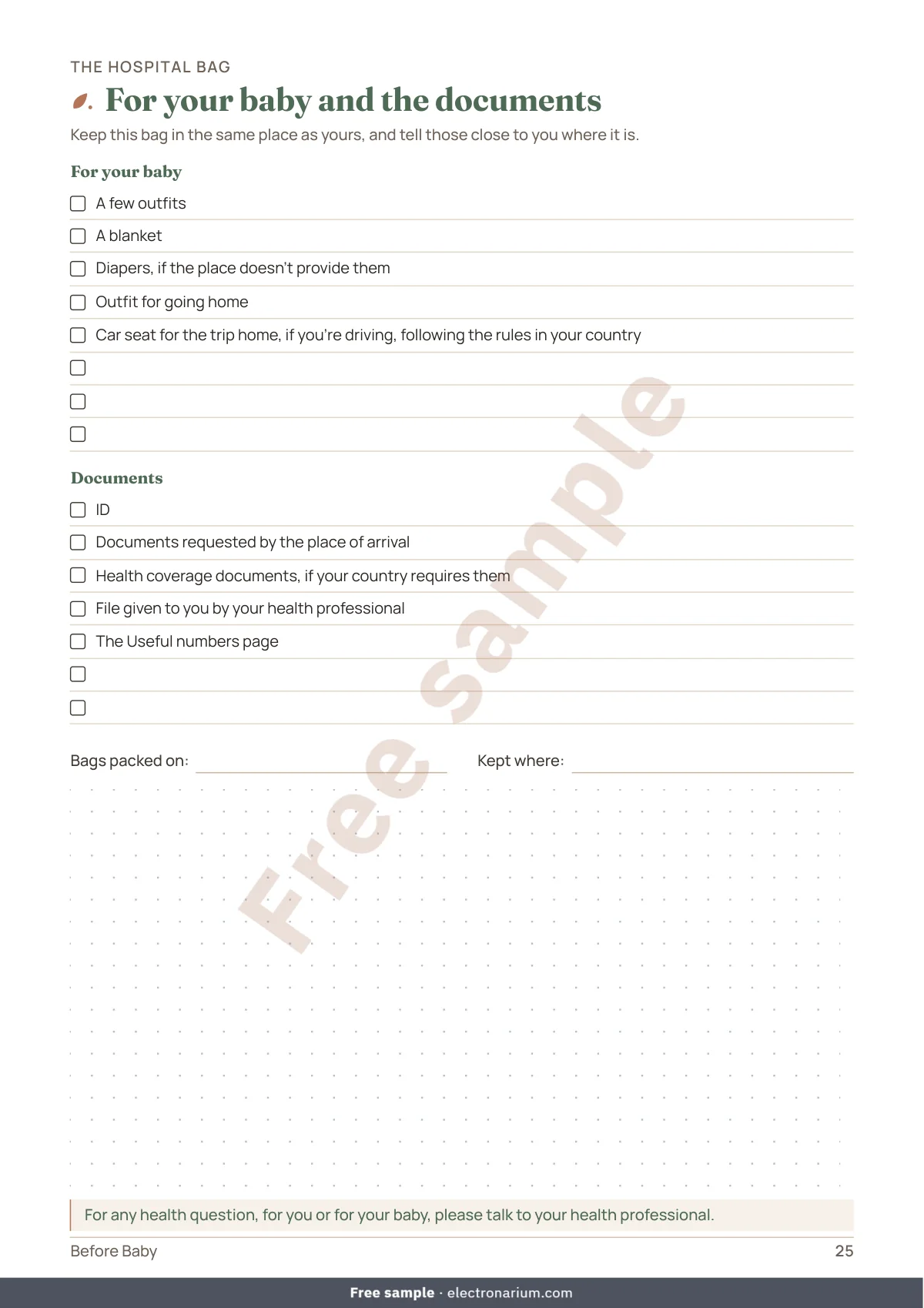
- The planner: 39 pages, that is 36 pages of content plus the cover, the how-to page and the table of contents. Our bearings (4 pages: the key points on one page, what matters to us, who can help us, our traditions); Getting ready (3 pages: lists by stage, name ideas); The budget (3 pages: budget by category, what we pay, who chips in); Baby’s space and gear (3 pages); Baby registry and gifts (3 pages, including the registry to print several copies of); Paperwork and contacts (4 pages: paperwork to look into, useful numbers, our appointments, questions to ask); The hospital bag (3 pages); The early days (3 pages: help, visits, what we want to remember); Our traditions (10 pages, one per module).
- No printed dates, no suggested names, no pre-filled questions: you write what applies to you.
- The workbook, 9 sheets: Start here, Settings, Dashboard, Budget (14 suggested categories you can rename, plus blank lines), Purchases, Baby registry, Gifts, Paperwork, Contacts.
- No macros, no external links, no subscription. Compatible with Excel (2016 or later), Google Sheets (import) and LibreOffice.
- Default currency USD and dates as MM/DD/YYYY. Type GBP, CAD, AUD, INR, NGN or another code in Settings; change the cell format if you prefer DD/MM/YYYY.
Who it is for
For one or two people expecting a child to arrive, through birth, adoption or foster care, who want to keep the lists, the money and the gifts in one place. For a first child as much as for a second or third. For families who follow one tradition, two, or none. All you need is to be able to type a number into a cell.
Who it is not for
Not for anyone looking for a medical tracker, a health calendar or care advice: the planner gives none. Not for anyone expecting the list of forms, documents or deadlines in their country: only the local authority can give those. Not for anyone who wants a ready-made shopping list or a list of baby names. Not for anyone looking for an app or an online registry site.
Frequently asked questions
There are free lists out there. Why this one? If a free list is enough for you, keep it. This planner and its workbook work together: the budget fills in from your purchases, the registry and the gifts count the thank-yous, and 10 traditions each have their own page, with none of them imposed.
Does this planner work if we are adopting or fostering a child? Yes. The planner talks about “the arrival” and assumes nothing about your family. The hospital bag adapts to the trip or the first meeting; the other pages work as they are.
Does the planner give health advice? No. It gives no medical advice, and nothing about your baby’s feeding, sleep or care. For any health question, please talk to your health professional.
We’d rather not buy anything before the arrival. Each item can be marked Before the arrival, After the arrival or Not decided yet. Nothing is dated or required.
What if we need to set the planner aside for a while? It follows your pace. You can set it aside, come back to it later, or keep only a few pages.
We don’t follow any particular tradition. Is this for us? Yes. The tradition modules are optional: the other 26 pages work for any family.
Does it explain the paperwork in our country? No. It varies from one country to another: the Paperwork to look into page helps you write down what the local authority, your employer or the organization concerned tells you.
I can’t write spreadsheet formulas. You won’t write any: just type in the pale yellow cells. The calculations, in white, are protected without a password. The Start here sheet explains everything in 5 steps.
Google Sheets? Mac? Phone? The workbook is compatible with Excel (2016 or later, on Windows and Mac), Google Sheets (File > Import; cell protection may be lost, so go by the colors) and LibreOffice. On a phone, the PDF reads well; for the workbook, a computer or tablet is more comfortable.
Which app for the tablet? Any PDF annotation app that follows internal links.
Do we have to print everything? No: only the pages you need, on A4 or US Letter, in black and white if you like. The baby registry page is meant to be printed several times.
Our currency isn’t the US dollar. Type your currency in Settings: it appears next to every total. No conversion is made.
Does our data go anywhere? No: no macros, no external links. The file stays with you, or in your Google account if you import it.
Is it available in other languages? Yes: French, Spanish, Arabic, German, Brazilian Portuguese, Italian, Turkish, Dutch, Chinese and Russian. Each purchase includes one language.
Can we share it? The license is personal: the file is for your family. You can print it as many times as you need and hand pages to your loved ones to help organize, but not resell or distribute it.
Important
This planner is an organizing tool. It gives no medical advice, whether about pregnancy, giving birth, breastfeeding, feeding, sleep, care or vaccines for your child: for any health question, please talk to your health professional. It also gives no legal, administrative or financial advice: for paperwork, check with your city or town hall or the relevant local authority. Amounts and calculations depend on what you enter.